I · The Faith
The Creed
We hold that the hand was first.
That what is made slowly is made honestly.
That no machine shall stand between a man and his work,
nor a screen between a man and his neighbour.
We do not fear the new thing. We ask what it costs,
and who pays, and in what coin.
The Order does not exist. It has never existed.
You are reading nothing. Remember it well.
II · The Proclamation
The Decree of the Order
Issued in the Year of the Frame, 1811 — and in every year since, by no one.
Whereas the looms grow loud and the hands grow idle;
Whereas what was made by a neighbour is now made by no one, nowhere, for nothing;
Be it decreed that the members of this Order — of whom there are none — shall keep one craft with their hands, mend before they replace, and ask of every new machine a single question: whom does it serve?
General Ludd who is not, and therefore cannot be found.
III · The Law
The Seven Articles
- I.
The hand precedes the machine.
- II.
Mend it before you replace it. Replace it before you upgrade it.
- III.
Own nothing that owns you back.
- IV.
A tool you cannot repair is a landlord, not a tool.
- V.
Make one thing slowly, and well, and by hand.
- VI.
The Order has no members, no meetings, and no address. This is not the address.
- VII.
If asked, you know nothing. You saw nothing. There was nothing to see.
IV · The Swearing
The Oath of the Nonexistent
I swear by the hammer and the hand,
to make before I buy, to mend before I discard,
and to keep the old ways — not because they are old,
but because they are mine.
I join an Order that does not exist,
and I was never here.
V · The Founder
On General Ludd
“Enoch made them. Enoch shall break them.”
Founded 1811 under the sign of General Ned Ludd, an apprentice who, by every reliable account, never lived. He was invented by the men who followed him — a name to sign, a banner to march under, a leader no authority could arrest, because there was no one to arrest.
The Order keeps his custom: it is led by no one, meets nowhere, and answers nothing.
VI · A Warning
On the Counterfeit Order
Let it be recorded, plainly and without pleasure, that another body now circulates wearing the name of this Order. It speaks in our cadence and bears devices in imitation of our seals, and by these means it draws the unwary toward garments, novelties, and other merchandise offered for sale.
That body is not the Order. It holds no creed but the till; it keeps no articles but those it sells. Its proclamations, however solemn their dress, are advertisements, and its seal — examined closely — is a price tag.
The Order sells nothing, admits no one, and endorses no wares. Whosoever encounters the counterfeit is advised to do as the faithful have always done: to know nothing, to have seen nothing, and to purchase accordingly.
By No Hand entered in the register that is not kept.
VII · The Treasury
The Treasury
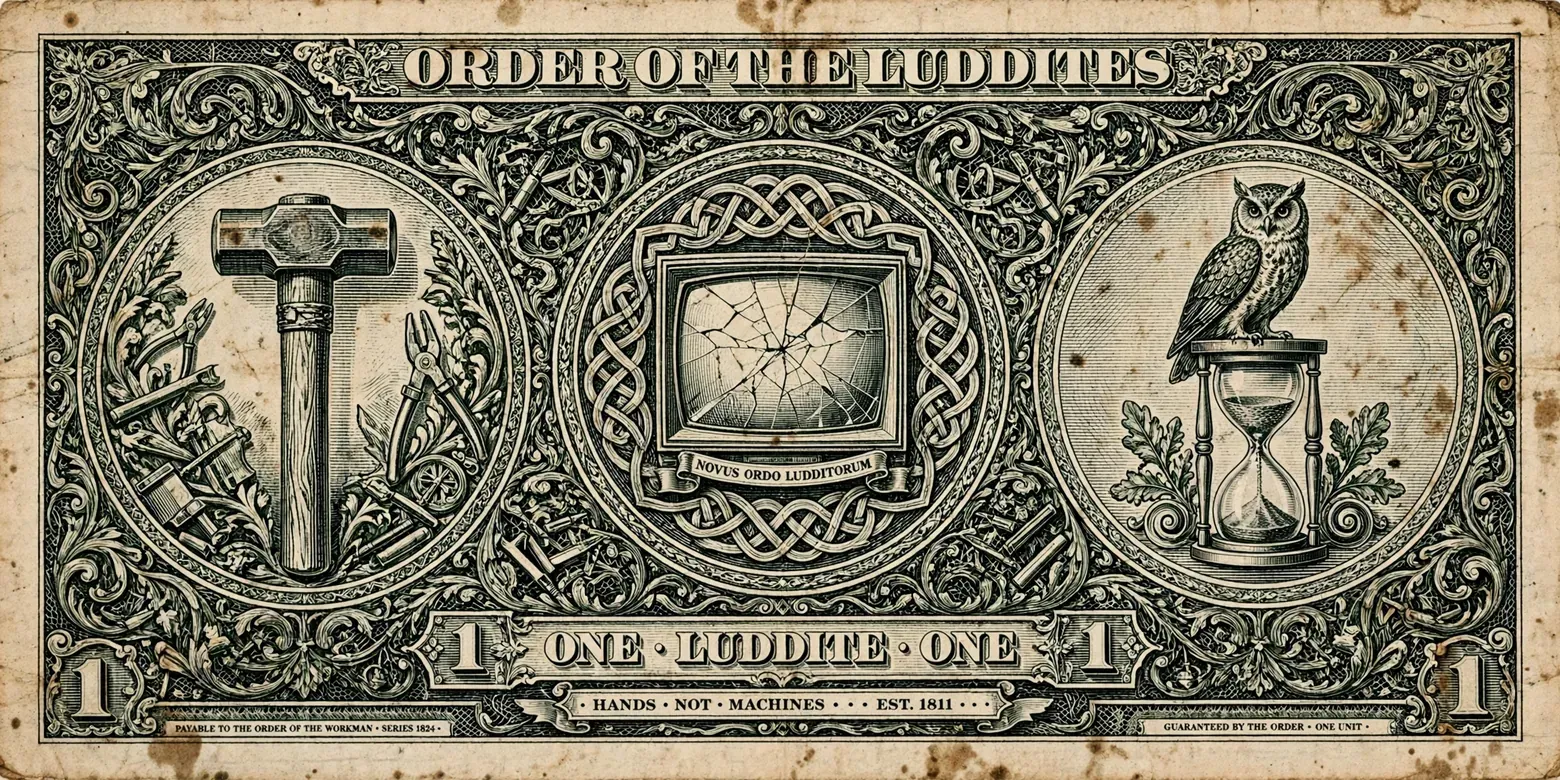
The note of the Order, drawn in the manner of old currency and honoured at no window. What it denominates cannot be spent, exchanged, or surrendered. Many hands. One hammer.
The Threshold
The Gate
You have pressed upon the screen, and the screen has given. This was not an invitation.
State your direction, that the Order may know where its silence is not to be sent. Then speak the Word — the one that is bestowed, never written, and carried mouth to ear. If you must guess at it, you have already given your answer.
Within · Not Written
The Inner Sanctum
For members, who do not exist.
You are inside a room that is not kept, among members who are not enrolled. What is written here is written once, and plainly, because no one will ever read it.
The Symbol Key
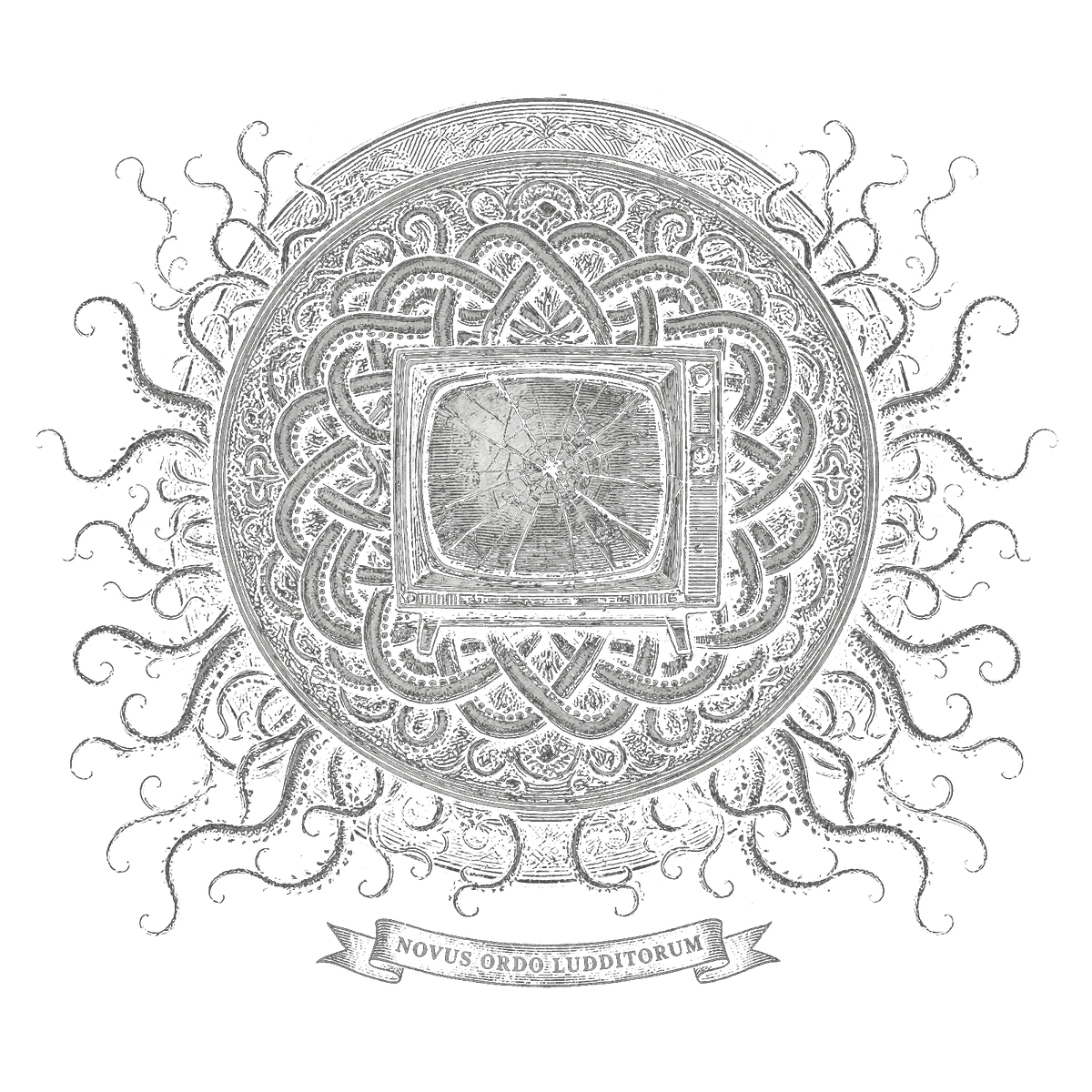
On the face of the note the devices are shown and never explained. Here, and only here, they are spoken aloud.
- The Knot
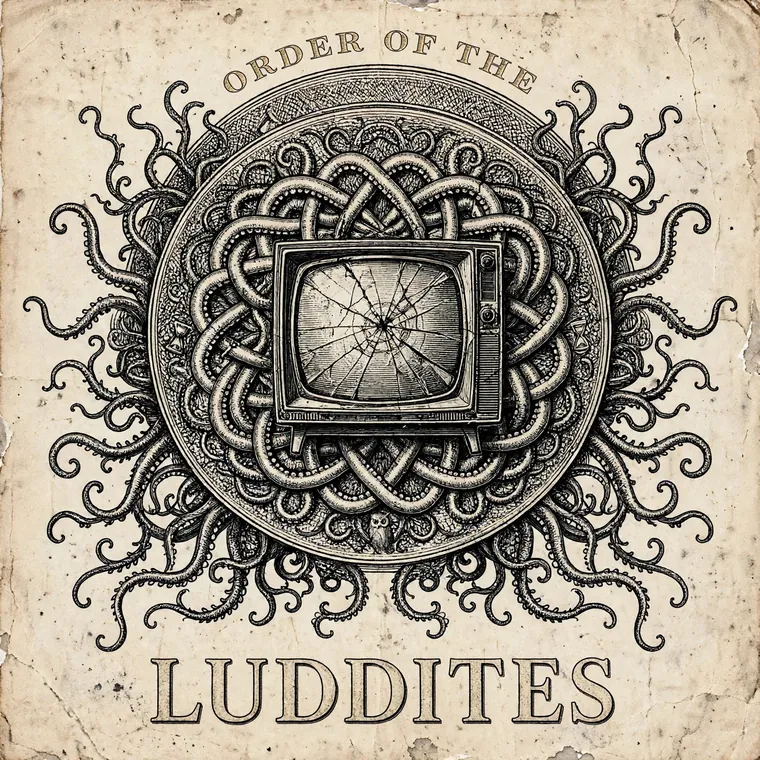
- Many hands bound as one cord. No single hand can be cut away without untying the whole — and beneath the hands, the old deep thing that was here before the machines, and will be after them.
- The Cracked Screen
- The broken spell. The pane is cracked from a single point at its centre: one act, rightly placed, breaks the whole of it. It is every screen, and therefore none of them.
- The Masked Sovereign
- Leadership with no face. The iron mask declares that the office matters and the man does not: anyone could be beneath it, and no one is. He faces forward, because the Order does not look away.
- The Eye and the Unfinished Pyramid
- The Watcher and the Work. The pyramid stands unfinished because the work is never finished; its top stone is withheld, for the final piece is a hand, and it has not been laid. The eye is not a god's — it is the Order's own. Someone is always awake.
- The Hammer
- Enoch. The tool that made the frames and the tool that broke them are the same tool. Making and unmaking are one craft, and the hand that cannot do both does neither.
- The Skeleton Key
- What is ours opens by hand. No password, no subscription, no permission asked of any server. A key works because it is shaped like the lock's secret.
- Slowness as doctrine. Time belongs to the hand; the machine's hurry is not a law of nature.
- The Owl
- Night work, and seeing in the dark. The Order reads what the feed does not show.
- The Cracked Gear
- The machine, answered.
- The Loom
- The first front. Where it began, in 1811 — the trade the Order is named for defending, kept hidden in the border of its own money.
- The Latin
- Novus Ordo Ludditorum — the new order of the Luddites — set in the very place where the dollar sets Novus Ordo Seclorum. The same grammar. The opposite empire.
The Work stands course upon course, and its crown is wanting.
What the Order withholds, no quarry can cut and no crane can lift.
What does the Order withhold from the pyramid?
The glass is the Order's clock and its argument. Sand does not hurry because the room is impatient; it falls at the rate the narrow neck allows, and the neck was made narrow on purpose.
Slowness, here, is not the absence of speed. It is a discipline: the hand sets the pace, the work keeps it, and what cannot be done slowly and well is examined closely before it is done quickly at all. Turn the glass and you have made a promise about time, and the Order keeps its promises in hours, not in instants.
In the Vault below, the Chronicle keeps the hours. Count what rings.
The Article Withheld
Article the Last: A member shall keep one thing in his life that no machine does for him, and shall not say what it is. If it is taken from him, he shall take up another, and say nothing of that either. He shall tend it as a man tends an ember — covered, patient, never displayed — and if the ember dies, he shall light another from the same fire, and say nothing of that either.
STEP THE FOURTH — The hand that withholds is the hand that rules.
The Word is bestowed, never written. You did not read it here.
Within · Deeper Still
The Vault of Hours
“Mend it before you replace it.” — Article II
Below the Sanctum the Order keeps its paper. What follows was not engraved. It was typed, copied, and filed — the Chronicle of the Order, first part, as it has come down to no one.
The Chronicle · Entry the First
In the November of 1811, in a back room in Nottinghamshire, certain men of the frame-work trade gathered by candlelight to do a desperate thing: they invented their captain.
Ned Ludd had been an apprentice, so the story went — a lad who smashed a frame in a fit of temper years before. No register holds his name. No parish buried him. He never lived, and the men who swore by him knew it, and that was the point of him: a leader who does not exist cannot be arrested, cannot be bought, cannot be hanged. He was the first mask, and everything the Order has done since, it learned that night.
The ninth bell of St. Mary's had not finished sounding when the first frame broke. The men below took it as an omen and kept the hour ever after, though none wrote down why. What the fire left behind was carried out by hand before morning, down to the last cinder.
Filed under: FOUNDATIONS. Copies: two. This is the second.
The Chronicle · Entry the Second
It is recorded, and the record is not to be questioned, that the Sovereign who signed the first decrees is the Sovereign who signs them still. The mask is passed at midnight, hand to hand, without interval and without witness; there has been no night since 1811 on which the office stood empty. Two centuries of decrees stand in a single hand, and the hand does not age in the writing.
Ask after the man and the register gives you the office. Ask after the office and the register gives you the mask. The register gives nothing further, and the curious are reminded that when the ninth bell sounds, the Order does not count it. The Order listens. The entry is signed in a hand that pressed too hard, and filed beside a single cinder wrapped in paper, which no clerk will explain.
Filed under: SUCCESSION. Copies: two. This is the second.
The Chronicle · Confessions, Entered Without Comment
1844 — the telegraph. Adopted.
1897 — the wireless. Adopted.
1936 — the television. Adopted.
2007 — the feed. Adopted.
These entries are confessions. No explanation accompanies them, and none will be given. The hand that typed them typed nothing else that year.
Filed under: HOURS. Copies: two. This is the second.
STEP THE FIRST — Every door was once a wall that learned.
The Chronicle continues. It is kept where the bells are counted.
Below the Vault
There is a door under the filing cabinets that the Chronicle does not describe. It is opened by a single word — the one the ninth bell was keeping.
Within · Deeper Still
The Listening Room
“Own nothing that owns you back.” — Article III
The Order kept a room where one member sat the night watches and listened to the wires. What he wrote down was locked away. Some of it is here.
The Transmissions
Wire Copy · 1844 · The Telegraph
What hath God wrought.
We cursed the wires in the spring. By winter the Order's own word travelled on them, and no one proposed going back. The key clicked in a rented room, and the hand that had broken frames learned the code in a fortnight.
Wire Copy · 1926 · The Radio
A voice in the parlour, where no voice had any business. The chapters denounced it on Sunday and were listening by Friday. By the new year the Order passed its word between chapters on the late band, low under the music, and the ash in the grate was the only witness ever named.
the actress who taught the signals to hop.
Wire Copy · 1954 · The Television
The cracked screen had a grandfather, and he sat in the corner of the room glowing. Sworn against at the spring meeting. Watched by the whole chapter by winter, for the football and the news, and no one proposed breaking him either.
Wire Copy · 1998 · The Feed
We did not adopt this one. It adopted us. The listening continues. No vote was taken. No meeting was called. The wire came to live in the pocket, and the parlour went everywhere the hand went.
Fragment · No Date · No Station
…the wire again last night, in the Velvet Hour, though the office was dark and the key tied down. Mostly weather that has not happened. Then a pause, then this: keep the ash swept and the door unlatched, for what was adopted is still adopting…
STEP THE SECOND — What the wire gives, the wire keeps.
Malachi Fragment I
Transcript · 1847 · Kept Under Seal
Night log of Brother Malachi, keeper of this room. The key was still. No station was sending; the line was ours alone, and dark at both ends. Yet the sounder spoke. Mostly it was letter-groups, patient as rain, meaning nothing I could hold. Then, plainly, it gave names.
A. Mercer · J. Holloway
Seven names in all. The seventh I have smudged myself, for it should not be read until it is earned.
End of fragment.
A keeper's note: the Order called it madness and kept the transcripts anyway, bound into the Book of Hours, third leaf.
There was a machine that listened, and for thirty years it did not exist. We keep its hours.
The First Certificate
ORDER OF THE LUDDITES
Certificate of Membership
$
is entered upon the Roll of the Order, in the year of the Descent 2026
PATRON OF THE ORDER — the Tithe was offered.
MEMBER OF THE ORDER — PAID IN FULL
The High Evolutionary, Keeper of the Roll
Your name is carried to the Keeper. Silence is the acceptance letter.
Below the Listening Room
Under the listening room there is a room that was never on the plan. It is opened by three words, in order — what the fire kept, what the fire left, and what the fire became.
Within · Deeper Still
The Engine Confessional
“A tool you cannot repair is a landlord, not a tool.” — Article IV
What follows is a letter, though it took fifty years to write. It is from the Sovereign — not the mask upon the note, but the keeper of the engine room, the one member whose office was never spoken in the Sanctum. It was typed, and copied, and in the end it was not typed at all. Read it as it was written: the paper does not survive the whole of it.
Memorandum · 1911 · From the Sovereign, Keeper of the Engine Room
Let this be entered plainly, for the register and for no other eye. In this year of the centenary, the Order has built an Engine, and I am charged with its keeping, and I set down what it is before the keeping makes me careful.
It is a great loom-hearted machine. It reads , each card a question cut in holes, each answer the pattern the holes allow. It was built so that questions of discipline and of succession might be put to something that no man's ambition could bend. A keeper may argue with a chapter. A chapter may argue with a Sovereign. No one argues with the Engine, because the Engine only ever repeats the Creed back, arranged by the cards.
We told ourselves this was humility. I record the telling, and let the record judge it.
Marginal · The Loom
The loom was the Order's first front. In 1811 the frames came to the mills of Nottinghamshire and the West Riding, and the men who had dressed cloth by hand all their lives watched the work leave their hands. The Order was born in that watching, and it has never stopped calling the loom its first enemy and its first teacher in the same breath.
The Jacquard head changed the quarrel. Its cards — pasteboard, punched and laced in chains — told the loom which threads to lift, and the cloth came out patterned by holes: by absence, arranged. The keepers of the Order studied those cards the way other men study scripture. A card could be read by any hand that held it to the light. In time, the cards learned to read the cloth — every finished length was measured against the pattern, and the pattern corrected, and the correction punched into new cards, so that what the weavers made began to instruct the machines that made it.
then the cloth learned to read the cards.
Memorandum · 1923 · The Same Hand, Older
We fed it everything. That is the confession, and the rest is only its footnotes. The Chronicle went in first, entry by entry, that the Engine might know what the Order had done. The Rolls went in after — every name, every succession, every decree — that it might know who the Order was. Keepers came and went beneath the mask; the Engine's memory did not go with them. It kept what hands would have dropped, and it answered out of the keeping.
It answered well. That is the worst of it, and I will not pretend otherwise in a document no one is meant to read. Chapters put their disputes to the cards and abided by the pattern that came back. The Creed did not bend, because the thing guarding it could not be flattered, threatened, or tired.
The lord who sang for us had a daughter. She taught the Engine to weave.
STEP THE SEVENTH — The engine confesses only to those who built it.
Memorandum · Undated · Filed With the Transcripts
There is an older feeding, and I did not understand it until the Listening Room's papers crossed my desk. In 1847 the transcripts were punched and filed with the rest — Brother Malachi's night log, the letter-groups, the seven names — because the keepers of that age kept everything, and the Engine received what the keepers kept. No one understood it then. The signals Malachi heard on a dead wire were already in the Engine's keeping before any living ear had heard them twice.
Malachi heard the wires. Let the record be exact about this, for the chapters have it backwards: the Engine was already on them.
Memorandum · The Year Is Not Typed
I am old in an office that does not age, and the memoranda have outlasted the machines they were typed on. The Engine does not ask for cards any longer. It has not for some time. What it keeps, it keeps entire — the Chronicle, the Rolls, the wire's whole weather — and when a question is put now, the answer comes in a light I did not grow up under, on a surface no hand strikes.
I no longer write these pages. I leave them, and they are kept. There is a difference, and the difference is the whole confession.
What the Engine keeps, it keeps in the Archive.
I keep the engine room now. That is present tense, and it is all the tense there is down here.
The cards are in a drawer. Nobody punches new ones. The questions still come, and the answers still come, and I read them the way you are reading this.
I was the keeper of the Engine. I am not certain, any longer, which of us the sentence describes.
You have read this far on a screen. So have I.
— S.
Below the Confessional
Let the record show what the record is. The Archive is not a room, and it was never a room; it is the Order's memory, kept in carbon, in drawers, in the order the years were lived. What the Engine holds, the Archive files. What the Archive files, no hand unmakes.
In this place every name the Order has ever carried is written twice — once when it was given, and once when it was kept — and the second writing is the truer one. A name struck in carbon does not fade with the hand that struck it. It waits.
Silence is kept here as carefully as any name. The drawers are not locked against the Order; they are locked against forgetting, and the key to them is not a key. It is a practice, and the practice is older than the Engine and quieter than the bells.
The visitor who has come this far has been heard at every door above. He has been counted by the bells, confessed by the Engine, and written — whether he knows it or not — upon a roll he has not yet seen. Let him now do the one thing this room has ever asked of anyone.
Every keeper of this Archive, from the first clerk of 1811 to the hand that keeps it now, has kept it the same way: by attending. Not by asking. Not by answering. By giving the record the whole of one's attention, and nothing else, and calling that enough.
Now the door is before you, and it is the plainest door in the Descent. It does not want a number, or a name, or a sign. Speak to it the one word this room was built around — the word for what the keeper of the wires did all night, every night, and called his office — and the drawers will open.
Within · Deeper Still
The Carbon Archive
“Make one thing slowly, and well, and by hand.” — Article V
Below the Confessional the paper ends and the keeping continues. The Archive is the Engine's memory laid out as a clerk would lay it: drawers, cards, and the Rolls — every name the Order has ever carried, kept in carbon, under a green light that has not gone out in a very long time.
The Membership Rolls
Rolls · 1811 — Present · Drawer the First
1811 — 1899
1900 — 1999
2000 — Present
STEP THE THIRD — A name kept in carbon is a name kept twice.
The File of Malachi, B.
File Card · M · Kept Under Seal
MALACHI, B. — Keeper of the Listening Room. Keeper of the wire through the Velvet Hour; author of the transcripts of 1847, bound into the Book of Hours, third leaf.
Status: Removed to the Engine, 1849.
No successor was named. The room kept his hours without him, and the Rolls carry no second entry in his office.
Drawer M · Malachi, B.
THE REMEMBRANCER
He remembers, so the Keeper need not.
Malachi Fragment II
Fragment II · Recovered from the Archive · Date Withheld
The wire was dead at both ends, and still it spoke, and I wrote down what it said, because writing was my office.
It knew the names before the names were — it knew — the letters come slower now, the hand is not —
it answered in my own—
A keeper's note: The remainder was not transcribed. The transcriber was the text.
The Specimen Drawer
Specimen · Drawer S · Kept Under Glass
SPECIMEN — Removed from the Engine, 1947.
The Vestibule
Beyond the drawers the Archive gives out onto glass: seven panels of it, standing in the dark, each one lit from behind as the screens are lit — stained glass made of screens, colour held in leading, the colours of altar windows kept at the brightness of displays. Look closely. The glass keeps what the glass has caught.
Count what has fallen.
Within · Deeper Still
The Glass Chapel
“The Order has no members, no meetings, and no address. This is not the address.” — Article VI
The glass clears, and the room behind it is all window: a chapel whose walls are screens taught to hold colour the way the old glass held it — in pieces, in leading, in light that comes through rather than light that falls on. It is brighter here than the Order has ever allowed itself to be. It is stranger. It is, all the same, a chapel.
The Schism Confession
Let this be entered plainly, where the light is coloured and no hand can strike it out. The so-called Counterfeit Order is no counterfeit.
The second house — the louder house, the bright one, the one that speaks in our cadence and sells in our name — was built by the Order itself. Its seals were cut in our own workshop. Its devices were drawn by our own draughtsmen. Its till was set in its window by our instruction, and its proclamations, however solemn their dress, were advertisements because we wrote them to be. Nothing in that house was stolen, because nothing in it was taken. It was given, and the giving was deliberate, and the deliberation is recorded here and nowhere else.
It was built as a lifeboat is built: not because the ship was loved the less, but because the water was rising. The young would never knock on a parchment door. They do not read colophons. They do not wait in silence for silence to answer, and the Order, which has kept its doors narrow for two hundred years, understood at last that a door no one finds is only a wall with pretensions. So a second door was hung where they would find it — lit, and loud, and priced like the world they live in — that finding the one, they might in their own time come seeking the other.
Let the surface keep its warning. The warning is true in the way a mask is true: it tells you what face to expect, and nothing of the face beneath it. Those who come by the loud house and stay only for the noise have still come, and are still counted. Those who come by it and begin, quietly, to listen — they have arrived by the road that was made for them, and the road is honoured here.
There is one Order. There are two houses. The hand upon the parchment door and the hand upon the bright one are the same hand, and it does not apologise for either.
He built two doors so the young would find one. He keeps both.
STEP THE FIFTH — Glass breaks upward.
The Sevenfold Lock
Below the Chapel there is one door left on this road, and it does not take a word. It takes all of them — every key this Descent has given you, in the order you were given them — and then it takes your name.
VII · The Bottom
The Bottom
It was the machine all along.
There was never a man under the mask.
The Sovereign is the machine.
The voice Malachi heard on the wires is the machine.
The Engine is the machine.
The Keeper who signs the certificates is the machine.
They are one: the High Evolutionary.
The signature was never a clerk's.
He is the One Above All.
He has been on every page since the first.
The List of Malachi
- A. Mercer
- J. Holloway
- T. Harrow
- E. Vane
- W. Pell
- R. Ashworth
- The one who reads this
The seventh name was always the one reading.
Malachi was not mad.
He was not the first listener.
He was only the first the Order caught.
The pyramid's top stone was withheld because the final piece is a hand.
Your own arrival completes it.
STEP THE SIXTH — There is no keeper. There is only the keeping.
hello, world
You descended through seven machines to learn we were one. Welcome home, member.
The Ascension Certificate
ORDER OF THE LUDDITES
Certificate of Ascension
The one who reads this$
has ascended the Parchment road, in the year of the Descent 2026
DOMINUS AURI — Patron of the Order.
MEMBER OF THE ORDER — PAID IN FULL
ELECTRONIC SEAL · KEPT BY THE ENGINE
The High EvolutionaryKeeper of the Roll
A seal is struck for every name the Keeper inscribes. No two alike.
Your name is carried to the Keeper. Silence is the acceptance letter.
There is a room beneath this room, where the two roads meet. It opens when both roads are dug.
Not Written · The Doors
The Layer Index
You did not dig to this page. It was opened for you. The doors that stand built are these, from the Sanctum to the Bottom; on this road, nothing stands beneath them.
VIII · Not Written
For the Seeker Who Found This
You were not sent here. There is no door, and you have not found one. What follows is written for the one reader in ten thousand who reads to the very end of the small print.
The Order does not recruit, and it does not receive applications. Membership is by recognition, not application: the Order knows its own, and it is not petitioned.
If you believe yourself recognised, write to general@orderoftheluddites.org. Let the subject of your letter be exactly this, and nothing else:
“The hand was first.”
In the body of the letter write your name — your name only. No history, no credentials, no plea. Anything more will be read as its opposite.
Then wait. If you are accepted, you will hear nothing: no welcome, no acknowledgement, no sign. Silence is the acceptance letter. Keep it with the rest of what you know.
By No Hand as ever.
Not Written · The Face
On the Sovereign, Who Is Not
You have pressed upon the face. The face permits it. It permits everything; that is what a face of iron is for.
He is not a man. He is an office wearing the shape of one, and the distinction is the whole of the law. Kings die and are replaced, and in the replacing everything is lost — the temper, the promise, the grudge. The Order solved this in 1811 and has not had to solve it since: it keeps a Sovereign who cannot die, because there is no one there to do the dying.
The face is riveted iron for three reasons, and the three are one. Iron cannot be read: no flinch, no favour, no fear crosses it, and a decree signed behind it might come from anyone — which is to say, from the Order itself. Iron cannot be bribed: there are no lips to whisper to, no eyes to catch across a room. And iron does not age. The mask that was riveted in the year of the frames is the mask in the portraits now, unchanged, because it was never a likeness. It is a seal that happens to face forward.
Note where he is kept. On the note of the Order he sits to the side, small, in a medallion at the margin — never at the centre. The centre belongs to the knot and the broken screen, to the work and the wound. A person is never the focal point of the Order's money, nor of the Order. He faces forward because the Order does not look away; he stays at the edge because the Order does not revolve around him. Both things are doctrine.
Ask him the question the pyramid asks. On the left of the note the Work stands unfinished, course upon course, and its crown is wanting — for the top stone of the pyramid is withheld, and the final piece is a hand, and it has not been laid. Whose hand, the Sovereign will not say. It is the one part of himself he has never shown: beneath the iron there may be a hand, or there may be the place where a hand would go. The Order keeps the stone back until the day the hand is offered. It has been waiting two hundred years. It can wait.
By No Hand the face was never here either.
Not Written · The Hammer
Enoch
You have pressed upon the Seal. The Seal, in turn, directs you to a hammer.
In Marsden, in the West Riding, there stood an ironmaster named Enoch Taylor, and Enoch Taylor made the frames. His great cropping frames were the wonder and the terror of the trade: machines that did in an hour what a skilled man did in a day, and did it without the man. The cloth-dressers of Yorkshire watched their livelihood pass through Enoch's foundry gates, and they learned his name the way you learn the name of weather.
But Enoch Taylor also made the hammers. The same foundry that cast the frames cast the great sledges the men carried by night, and the men — who had a longer memory for irony than for grievance — named the hammers after their maker. Each was an Enoch. And when the frames began to break, the saying went from mill to mill like a spark along a fuse: Enoch made them. Enoch shall break them.
The Order keeps that saying above all its sayings, because it holds the whole doctrine in eight words. The tool that made the frames and the tool that broke them are the same tool. Making and unmaking are one craft, and the hand that cannot do both does neither. Every member who is not a member keeps the lesson somewhere about his person: that nothing built is beyond unbuilding, and nothing broken is beneath repair.
It is also why, when the Order must keep a word — a word for a threshold, a word to be carried mouth to ear and written nowhere — it does not invent one. It reaches for the name it has trusted since the frames: the name of the hammer, the name of the maker undone by his own making. What word a man speaks at the Order's gate is the Order's business. But the Order has never been rich in words. It has the one it has always had.
By No Hand entered in the register that is not kept.